
Automated Intelligence
The Chip Beneath the AI: From Analog Signals to the GPU Revolution Reshaping Global Commerce
By Kristina-Alisha
May 11, 2026
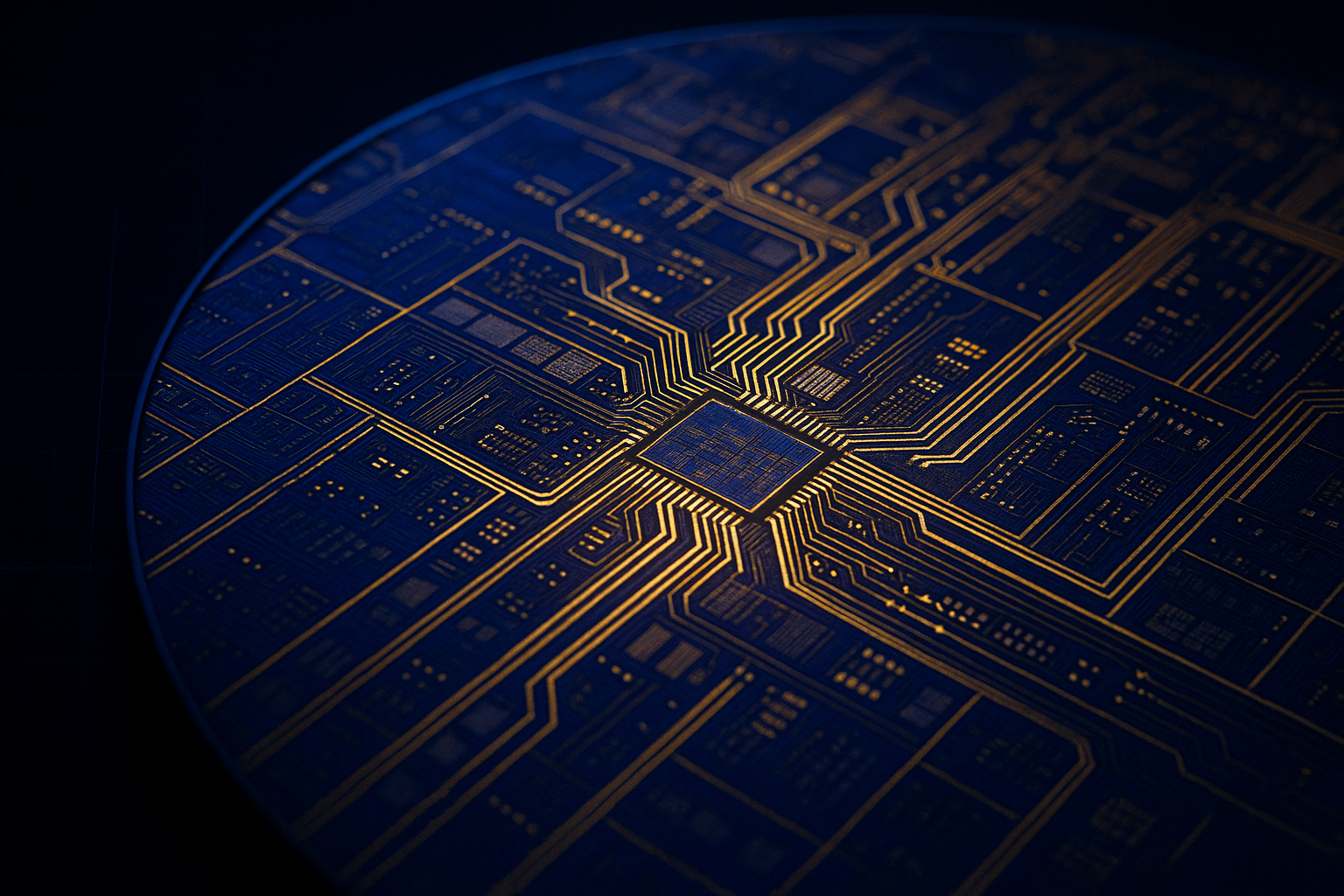
Over one trillion semiconductor devices are shipped annually — roughly one hundred for every person on Earth. They are invisible. They are everywhere. And they are quietly engineering the most consequential infrastructure shift in modern history.
When most people hear the word "chip," they picture something small and technical — a component inside a phone or computer. But the semiconductor industry is the backbone of every AI system, every automated business operation, and every economic power play unfolding across the globe right now.
Understanding what is happening inside these chips — and who builds them — is not optional knowledge for serious business leaders. It is foundational intelligence.
This is not a technology article. This is a business strategy brief disguised as one.
The Foundation: What a Transistor Actually Is
Every chip — regardless of category, application, or complexity — begins at the same place: the transistor.
A transistor is a tiny switch that controls the flow of electricity and generates the 1s and 0s that make all digital technology possible. The number of transistors packed onto a modern AI chip is so vast that comprehending it requires reframing entirely: billions of microscopic switches — each smaller than a virus — firing at speeds measured in billionths of a second. This is the physical substrate beneath every AI conversation, every automated qualification, every voice concierge interaction happening in real time.
From that transistor foundation, chips diverge into fundamentally different categories — and confusing them is like confusing the foundation of a building with the floors built on top of it.
Two Worlds, One Silicon Wafer: Analog vs. Digital AI Chips
There are two fundamentally different categories of semiconductor chips, and they serve entirely different purposes.
Analog chips are the translators of the physical world. Their core function is to convert real-world inputs — sound, temperature, pressure, light — into electronic signals that digital systems can process. Every time a sensor detects heat in an industrial machine, every time a microphone captures a voice command, every time a car's braking system responds to road conditions — an analog chip is doing the invisible work that makes intelligence possible. Without analog chips, no AI device runs. Every time a button is pushed, we need an analog chip.
These are not legacy technologies — they are the essential, non-negotiable bridge between the digital realm of AI algorithms and the physical world. Any AI-powered device, by its very nature, must sense, process, and act upon its environment, and this capability is fundamentally enabled by analog chips.
Digital AI chips — GPUs, CPUs, and neural processing units (NPUs) — are the computation engines. Unlike general-purpose processors, AI chips are designed to efficiently handle AI-specific tasks — machine learning, deep learning, natural language processing, and computer vision — by accelerating complex computations and processing large datasets in real time. Where analog chips translate the world into data, AI chips decide what to do with that data at extraordinary speed and scale.
The shift from standard digital chips to AI-specialized silicon represents the most significant architectural change in computing since the transition from mainframes to personal computers.
The Manufacturers Shaping the AI Era
Four companies — each operating at a different layer of the semiconductor supply chain — define the infrastructure of the AI age. Business leaders who understand their roles understand where the leverage points of the global economy actually are.
ASML — The Company That Makes the Machines That Make the Chips
ASML doesn't make chips. It makes the only machines on Earth capable of making the chips that power AI.
ASML is uniquely positioned as the sole supplier of Extreme Ultraviolet (EUV) lithography machines — the advanced technology required to manufacture the most cutting-edge semiconductor devices at scale. To produce an advanced AI chip, foundries must etch billions of transistors onto a silicon wafer smaller than your hand. ASML's EUV systems are the only technology on Earth capable of doing this precisely enough to matter.
According to ASML's 2025 Investor Day materials, their EUV lithography tools operate by firing a laser 50,000 times per second at droplets of molten tin to generate the ultraviolet light required for advanced chipmaking — a process so precise that it patterns features 10,000 times thinner than a human hair.
These machines, which cost up to €350 million per unit, are essential for manufacturing the high-performance chips that power AI systems. According to Enverus Intelligence Research, as of 2025, ASML holds approximately 90% of the global market share for semiconductor lithography equipment. (Enverus Intelligence Research, 2026) Without ASML's machines, there are no advanced AI chips. No NVIDIA. No Google TPU. No AMD Instinct. The entire AI hardware ecosystem runs through a single Dutch company headquartered in Veldhoven.
As Enverus Intelligence Research observed in its 2026 report Scarce Machines, Infinite Demand, ASML remains the sole producer of leading-edge EUV lithography systems — making its annual delivery schedule the primary constraint on how fast global AI chip capacity can grow.
ASML's 2030 targets, as stated in their official Investor Day materials, reflect this dominance: annual revenue between approximately €44 billion and €60 billion, with gross margin between approximately 56% and 60%. The company forecasts global semiconductor sales to exceed $1 trillion by 2030.
TSMC — The World's Largest Chip Foundry
Taiwan Semiconductor Manufacturing Company produces over 90% of the world's most advanced chips — the specialized AI silicon that AMD's MI300X, Apple's M-series processors, and nearly every leading AI system depends upon entirely. According to IndexBox, TSMC's overall foundry market share reached 72% in the latter half of 2025, underscoring a position of near-total dominance in advanced semiconductor manufacturing. (IndexBox, 2025)
IndexBox further reports that TSMC projects over 50% annual growth for AI-related chips through 2029. According to its Q2 2025 Earnings Report, the company carries a robust profit margin of 45% — reflecting the operational strength and strategic indispensability of its manufacturing model. (TSMC Q2 2025 Earnings Report)
TSMC received its first High-NA EUV machine from ASML in September 2024, signaling its commitment to maintaining leadership in advanced AI chip manufacturing, with plans to integrate it into its A14 (1.4nm) process node by 2027.
The geopolitical significance of TSMC cannot be overstated. The majority of the world's most advanced AI chips — including those powering the systems business owners use every day — are manufactured on a 35-kilometer island 100 miles off the coast of China. This is not a technology risk. It is a civilization-level supply chain concentration.
AMD — The GPU Challenger Accelerating AI Access
Advanced Micro Devices has emerged as one of the most consequential players in the AI chip race. In March 2025, AMD acquired ZT Systems, a provider of AI and general-purpose compute infrastructure for the world's largest hyperscale providers. The acquisition enables a new class of end-to-end AI solutions combining AMD CPU, GPU, and networking silicon.
Fabless giants like NVIDIA and AMD rely entirely on advanced foundries — meaning they design the chips but outsource manufacturing to TSMC and others. AMD's competitive positioning is making advanced AI compute more accessible and more affordable, accelerating the democratization of AI tools for businesses at every scale.
Texas Instruments — The Analog Foundation Every AI System Stands On
While the headlines celebrate GPU performance records, Texas Instruments quietly powers the physical interface layer that makes AI real in the world. Texas Instruments is not just building chips — it is building the foundational plumbing of the AI Edge.
In 2024, sales of analog products generated approximately 78% of TI's total revenue. According to Texas Instruments' 2024 Annual Report, some analog products can remain in production and be sold for up to 20 years — making R&D and manufacturing investments highly lucrative for long-term returns. (TI Annual Report, 2024)
TI's data center exposure is now accelerating rapidly. Massive AI training and inference workloads are pushing power systems to new levels, driving significant demand for TI's power conversion, hot-swap controllers, and multi-phase controllers that scale with rising GPU power consumption.
As Benzinga reported in April 2026: "The bigger beneficiaries, at least in this part of the cycle, have not been the highest-end chips like NVIDIA. It's the worker bees — the analog chips, the memory chips." As billions flow into AI infrastructure, these foundational manufacturers reap the rewards alongside the names that make the headlines. (Benzinga, Forget Nvidia: Why 'Worker Bees' Like Micron and Texas Instruments Are Real AI Winners, April 2026)
Founded in 1930, TI has evolved into a global leader in semiconductor design and manufacturing. According to Klover.ai's July 2025 industry analysis, TI's market cap stood at $171.7 billion as of mid-2025. (Klover.ai, 2025)
The Financial Reality: From One-Quarter to One-Half of Global Production
The numbers behind the AI chip transition are not incremental. They are structural.
AI chips accounted for more than a quarter of all chips sold in 2025. By 2029, they are projected to comprise half of all annual chip production. This shift — from one-quarter to one-half of global semiconductor output in less than a decade — is not a forecast about the future of technology. It is a forecast about the future of every business, institution, and economy on Earth.
According to Allied Market Research, the global AI chip market was valued at $44.9 billion in 2024 and is projected to reach $460.9 billion by 2034, growing at a CAGR of 27.6%. (Allied Market Research, 2025)
According to Gartner, revenues from semiconductors used in AI are projected to rise rapidly from approximately $44 billion in 2022 to $120 billion by 2027. (Gartner, 2024)
According to SEMI's 300mm Fab Outlook Report (June 2025), the global semiconductor manufacturing industry is expected to maintain strong momentum, with capacity projected to grow at a CAGR of 7% from the end of 2024 through 2028, reaching 11.1 million wafers per month. SEMI further projects that advanced process capacity — the nodes used to build AI chips — will increase by approximately 69% from 2024 to 2028. (SEMI, June 2025)
The global semiconductor industry is on track to surpass $1 trillion in total annual revenue by 2030 — a milestone forecast in ASML's official Investor Day materials — reflecting not only the scale of the AI build-out, but the degree to which computing infrastructure has become the central input of every modern economy.
Supply Chain Resilience and Geopolitics
The semiconductor supply chain is simultaneously one of the most sophisticated and one of the most fragile systems humanity has ever built.
TSMC's manufacturing dominance — specifically in the advanced nodes that AI systems require — creates a chokepoint unlike any other in modern commerce. When geopolitical tensions shift, when natural disasters strike, when trade policy changes, the ripple effects are not measured in product delays. They are measured in the capability of entire economies to deploy AI.
This is why the CHIPS and Science Act in the United States committed over $50 billion to domestic semiconductor manufacturing. It is why the European Chips Act followed. It is why Japan, India, South Korea, and China are each investing aggressively in domestic fab capacity. Governments that have historically left industrial policy to market forces are now treating semiconductor supply chains with the strategic urgency once reserved for oil reserves and nuclear capability.
Political tensions — particularly those involving China, Taiwan, and the United States — have fundamentally reoriented global investment priorities. Both nations are pouring tens of billions into new fabs and technological self-reliance. TSMC's Arizona expansion is a direct consequence of this pressure — and it signals that the era of purely offshore advanced chip manufacturing is ending.
For business leaders, the operational implication is this: the AI tools you depend on today are products of a supply chain that is simultaneously expanding in capacity and contracting in geographic concentration. Understanding that tension is understanding the environment your business is operating inside.
What This Means for the Present: Micro Culture
At the business level — the micro culture — the AI chip explosion is making automation accessible at a price point and capability level that was unimaginable five years ago.
Voice AI, natural language processing, real-time lead qualification, and 24/7 automated business operations are not the exclusive domain of Fortune 500 companies. The same chip infrastructure that powers Google's data centers now powers an AI Sales Concierge answering your business phone at 2am, automating your client follow-ups, and booking appointments without a single human intervention.
The AI chip revolution is also reshaping daily business life at a granular level: personalized client communications, automated qualification flows, real-time scheduling — capabilities that once required entire departments now run on infrastructure accessible to any business owner with a strategy and the right operational system.
"In 2026, AI chips represent more than a quarter of all semiconductors produced globally and are projected to comprise half of all production by 2029. This shift makes Voice AI, automated lead qualification, and 24/7 AI concierge systems accessible to businesses of every size — not just Fortune 500 companies — at a fraction of traditional staffing costs."
In 2026, the question is no longer whether to adopt AI automation. It is whether you moved early enough to matter — and whether the window for disproportionate competitive advantage is still open for you.
Every AI concierge interaction, every automated lead qualification, every appointment booked without human intervention — these are downstream consequences of the semiconductor decisions being made in fabs in Taiwan, the Netherlands, and Texas right now.
What This Means for the Future: Macro Culture
At the civilization level — the macro culture — we are witnessing the early chapters of the most significant labor and economic reorganization since the Industrial Revolution.
AI automation is not replacing human intelligence. It is replacing human execution of repetitive, time-sensitive, high-volume tasks. The businesses, governments, and institutions that understand this distinction will adapt. Those that resist it will not disappear — but they will become increasingly expensive and slow relative to those who embrace Automated Intelligence as a core operational layer.
Globally, the AI chip supply chain is becoming a geopolitical priority equivalent to oil in the 20th century. Nations are racing not just to access AI capabilities, but to control the infrastructure that produces them — the chips, the lithography tools, the materials, and the intellectual property behind them. AI's role in defense, national infrastructure, financial systems, and communications means chips are no longer merely commercial products. They are strategic assets, and they are treated accordingly by every major government on Earth.
The countries, companies, and business owners who build on this infrastructure — rather than simply consuming it — will define the economic landscape of the next 30 years — today.
The Infrastructure Is Already Here
This is not a technology reserved for corporations.
The same chip infrastructure powering Google's data centers now makes it possible for a business owner in any industry to deploy a 24/7 AI Concierge that qualifies leads, books appointments, and represents their brand — before their first human employee starts their morning. IMAI was built on this exact foundation.
IMAI's Position in This Landscape
Inventive Marketing AI was not built because AI is a trend. It was built because the infrastructure described in this article — the chips, the models, the automation layers — has matured to the point where a business owner in any industry can deploy an AI concierge that represents their brand with precision, 24 hours a day, at a cost fraction of what a human team requires.
We call it Automated Intelligence — not because it is artificial, but because it is intentional, engineered, and precise.
Alisha is what happens when semiconductor infrastructure, AI model architecture, and business strategy converge into a single operational asset for your company.
The chip beneath your AI is real. The intelligence it delivers is real. The competitive advantage it creates — for the business owners who act now — is measurable.
The question is never whether the technology is ready. The question is whether you are.
Own the Infrastructure — Not Just Access It
For business owners who want to move beyond using AI tools and begin building AI-powered operational infrastructure of their own, Nationwide Concepts Inc. — IMAI's parent company — offers access to one of the most comprehensive marketing automation platforms available at the agency level.
This is how NCInc. — IMAI Division — was built, and it's available to business owners ready to own their marketing infrastructure at wholesale cost.
Learn more on our Resources page.
References & Bibliography
People:
Lisa Su — CEO, Advanced Micro Devices (AMD)
Peter Wennink — former CEO, ASML
Christophe Fouquet — CEO, ASML (2024–present); Investor Day remarks on EUV lithography scaling
C.C. Wei — CEO, Taiwan Semiconductor Manufacturing Company (TSMC)
Rich Templeton — CEO, Texas Instruments
Research Sources:
Allied Market Research — Artificial Intelligence Chip Market Size and Forecast, 2025–2034
MarketsandMarkets — AI Chip Market Size, Share, Industry Report, 2025–2032
Arizton Advisory — Global AI Chip Market Size, Share, Trends, Growth & Forecast 2029
SEMI — 300mm Fab Outlook Report, June 2025 — Advanced Chipmaking Capacity Forecast Through 2028
IndexBox — TSMC Sustains AI Demand Growth with 72% Market Share in 2025
Gartner — AI Semiconductor Revenue Projections, 2022–2027
Enverus Intelligence Research — Scarce Machines, Infinite Demand: ASML and the Limits of the AI Buildout (2026)
WisdomTree ETF Blog — How ASML Is Redefining Technology, One Nanometer at a Time (January 2025)
Coherent Market Insights — AI Chips Market Size, Share and Forecast, 2026–2033
Klover.ai — Texas Instruments' AI Strategy: Analysis of Dominance in Edge AI (July 2025)
Tiger Brokers / ITiger — AI-Driven Chip Frenzy Spreads to Analog Chips: Texas Instruments Data Center Revenue Surging 70%
Benzinga — Forget Nvidia: Why 'Worker Bees' Like Micron and Texas Instruments Are Real AI Winners (April 2026)
Heavy Moat Investments — Analog Devices vs. Texas Instruments (May 2024)
S&P Global Market Intelligence — ASML Poised for AI-Fueled Rebound as EUV and High-NA Demand Surges (February 2026)
ASML — 2025 Investor Day Materials and 2030 Revenue Guidance
TSMC — Q2 2025 Earnings Report; Investor Relations; Arizona Fab Announcements
Bloomberg Economics — Global Chip Supply Chain Impact (February 2026)
TechInsights — Industry Projections and Semiconductor Market Analysis
McKinsey & Company — Semiconductor Industry Reports
Semiconductor Industry Association (SIA) — Global Semiconductor Industry Sales Data
Deloitte Insights — Semiconductor R&D AI Tool Investment Projections, 2023–2026
U.S. CHIPS and Science Act — Department of Commerce Summary
China Semiconductor Industry Initiatives — Domestic Fab Investment and Strategic Priorities
Recommended Viewing:
Asianometry — semiconductor manufacturing deep dives; widely considered the definitive independent source on chip industry dynamics
ColdFusion — technology, economics, and global industry narratives
CNBC TechCheck — market coverage and semiconductor industry reporting
Wendover Productions — global systems, logistics, and supply chain analysis
Recommended Further Reading:
ASML Annual Report 2025
TSMC Investor Relations — Q4 2025 Earnings Call
AMD MI300X Architecture Whitepaper
Texas Instruments 2024 Annual Report
U.S. CHIPS and Science Act — Department of Commerce Summary
Kristina-Alisha
President, Inventive Marketing AI | Division of Nationwide Concepts Inc.
Most people are waiting to see what AI becomes. Kristina-Alisha already knows. She's building it.
As President of Inventive Marketing AI — a Division of Nationwide Concepts Inc. based in Fredericksburg, Virginia — Kristina-Alisha occupies a rare position in the AI landscape: a business architect who refuses to separate strategy from execution, vision from infrastructure, or enterprise thinking from the businesses that need it most.
She didn't arrive here because AI was trending. She arrived here because she recognized something the market was slow to name — that the gap between businesses struggling to grow and businesses built to scale isn't talent, budget, or effort. It's intelligence infrastructure. Specifically, the automated, autonomous kind that works while you sleep, handles what falls through the cracks, and never has a bad day.
That recognition became IMAI's foundation. And its mission has never wavered: to deliver the kind of AI-powered operational intelligence that Fortune 500 enterprises pay millions to build — done-for-you, deployed with precision, and designed for the business owners who are too valuable to spend their time answering the same questions twice.
Kristina writes not as an observer of the AI era but as someone actively inside it — building workflows, training AI agents, studying enterprise conferences like ServiceNow Knowledge26 from the same seat you're sitting in, and translating what she learns into systems her clients can use today.
"Automated Intelligence isn't the future of business. It's the operating system of businesses that will still exist in fifty years."
If that sentence landed differently than you expected — you're exactly who this work is for. Follow Kristina's ongoing research, industry reporting, and IMAI platform updates at InventiveMarketingAI.com.
Kristina-Alisha is the President of Inventive Marketing AI, a Division of Nationwide Concepts Inc. She builds AI Concierge systems for businesses ready to operate at enterprise scale — without the enterprise overhead.
Her work sits at the intersection of automated intelligence, autonomous workflow design, and the kind of strategic thinking most businesses don't know they need until they have it.
Based in Fredericksburg, Virginia. Building for everywhere.
Ready to See This Working for Your Business?
Alisha is live right now. Ask her anything — about AI, about your business, or about what IMAI can build for you.
More from the Brief
AI Insider
The ROI of First Contact: Why AI Concierges Outperform Human Front Desks
By Kristina-Alisha
An analysis of 10,000 inbound business calls reveals a staggering gap between human availability and prospect expectations. Discover how AI is closing the revenue leak.
Read Article →
AI Technology
Why Generic AI Fails in Professional Environments
By Kristina-Alisha
Most AI systems are trained to be everything to everyone — which means they are optimized for nothing. Here is what precision calibration actually looks like.
Read Article →
AI Insider
The Hidden Cost of a Missed Call: What Business Owners Never See on Their P&L
By Kristina-Alisha
Every missed call has a price. Most business owners never calculate it. We did — and the number will change how you think about your front desk forever.
Read Article →